Tech
Wireless Connectivity In Modern Cars Powers Smart Rides
By milesteller
November 21, 2025
Field Notes
Ever think your ride might outsmart your phone? These days, even your everyday car buzzes with wireless connectivity, kind of like having a smart buddy riding shotgun. It chats with satellites, talks with traffic systems, and even stays in touch with your phone. Bluetooth, Wi‑Fi, and cellular networks all work together to keep you posted in real time. So when there's a sudden road change or a glitch in your engine, your car gives you a little nudge. Pretty neat, isn’t it?
Wireless Connectivity Essentials in Modern Cars
Modern cars are more than just machines, they’re like smart pals that stay connected. These vehicles use a mix of wireless tech such as cellular networks (from 2G right up to 5G and even LTE variants), Wi-Fi, Bluetooth, and GPS systems to keep in touch with the world. Think of it as your car’s way of chatting with satellites like GPS, GLONASS, Galileo, and BeiDou, sharing important details like speed, location, and safety alerts. Ever notice how your phone does the same thing?
This clever setup acts as the main nervous system of your ride, handling everything from sensor data to diagnostics and even software updates sent over the air. It’s like turning your car into a smart device that’s always aware of its surroundings. Picture your car as that friend who lets you know about a sudden road change before you even see it.
Currently, about half of all vehicles are connected, and experts expect that nearly all new cars will have this tech by 2030. Today, cars talk to each other and to traffic systems through three main channels, making them a key part of the Internet of Things. With this connectivity, both fleet managers and everyday drivers can check on vehicle health, ensuring each trip is safe, efficient, and smooth.
Core Wireless Technologies in Modern Cars
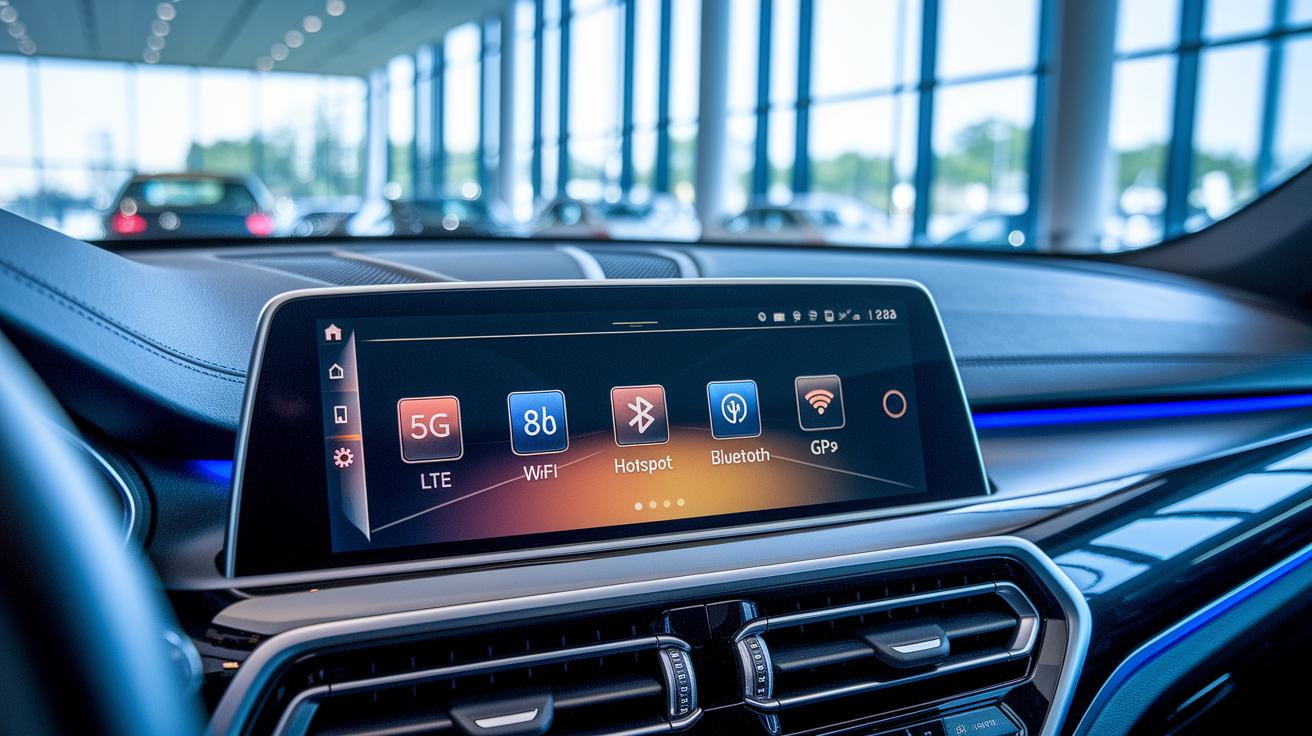
Modern cars pack a range of wireless systems that keep your drive both smart and safe. They use different cellular networks, like 2G, 3G, 4G, and 5G with LTE variants, to stay online for updates and diagnostics. Ever notice how handy it is to have internet on the go? Wi-Fi turns your car into a moving hotspot so everyone inside can connect easily. Plus, Bluetooth links your phone and other devices for hands-free calls and smooth media streaming. GPS and GNSS modules work with satellites such as GPS, GLONASS, Galileo, and BeiDou to nail down your location. And V2X? It connects your car with nearby infrastructure, boosting safety in real time.
| Technology | Frequency Band | Maximum Data Rate | Primary Use |
|---|---|---|---|
| Cellular (2G/3G/4G/5G) | Varies by network | Up to 100x faster than 4G (in 5G) | Data transmission & OTA updates |
| Wi-Fi | 2.4 GHz & 5 GHz | Mbps range | In-vehicle hotspots |
| Bluetooth | 2.4 GHz | Up to 3 Mbps | Hands-free pairing & streaming |
| GPS/GNSS & V2X | Satellite & dedicated RF bands | Varies | Location tracking & safety communications |
Each of these wireless technologies has its own job in turning today’s vehicles into smart, connected hubs. Cellular and Wi-Fi help power data-heavy tasks like up-to-date navigation and streaming your favorite tunes. Meanwhile, Bluetooth and the satellite modules keep your in-car experience smooth by ensuring steady connectivity and accurate location tracking. And with V2X linking your car to the nearby environment, drivers benefit from an extra layer of safety on busy roads.
Telematics Control Unit: Hub of Wireless Communication
Think of the TCU as the car’s brain. It gathers a steady stream of info from sensors all over your vehicle, covering things like how fast you're going, how the engine’s behaving, and even safety checks. It even handles over-the-air updates, so your car stays up-to-date without you lifting a finger. This smart unit lets your car tweak its own settings automatically while keeping a close eye on potential issues.
Today’s connected cars rely on the TCU more than ever. It combines several key parts into one compact system to keep data moving smoothly. Whether it's adjusting everyday settings or running critical system checks, the TCU has it covered. Here’s a quick look at what makes it tick:
| Component | Purpose |
|---|---|
| MCU | Handles real-time control |
| Application Processor | Runs telematics software |
| Cellular Modem | Ensures reliable network switching |
| Integrated IMU and MEMS Sensors | Tracks vehicle dynamics |
Key Applications: Infotainment, Diagnostics and Remote Services
Modern cars today aren’t just about getting you where you need to go. They create a smart, connected ride that makes every trip a bit more special. These vehicles use wireless connectivity to handle safety and performance info right on the spot. In simple terms, your car quickly figures out which details need urgent care and which can be sent off to the cloud for further check-ups later. This cloud link lets car systems be watched in real time, so issues can be predicted before they turn into bigger problems, even for large fleets.
Inside the cabin, you'll enjoy streaming options that mix audio, video, and live navigation updates to keep you informed and entertained. Plus, remote diagnostics work like a handy mechanic on call. They spot faults, run configuration checks, and even get repairs scheduled without you having to visit a shop. In a nutshell, the blend of onboard streaming, fast data processing at the edge, and cloud-powered monitoring is turning your car into a mobile, smart service center.
- Enjoy in-cabin streaming with fun audio/video options and live navigation updates.
- Get quick, real-time remote diagnostics that catch issues early.
- Experience predictive maintenance powered by the cloud to cut down on downtime.
- Benefit from edge computing that prioritizes and processes key vehicle data.
- Make use of advanced mobile services that offer comprehensive fleet monitoring and insights.
Over-The-Air Updates and Firmware Management in Cars
Ever notice how your car can get updates like your smartphone? Manufacturers now send firmware and software patches straight to your vehicle, so you won't have to visit a dealership. This modern approach uses eSIM technology that automatically picks the best network connection, keeping your ride connected and current.
Think of embedded telematics systems as the heart of your car's update process. They fully integrate these updates into your car's inner workings, so you get strong security and smooth performance. On the flip side, if you drive an older model, aftermarket modules can add some update abilities. They’re flexible and let older cars catch up, but they may miss out on certain data and might not be as secure.
It all comes down to balancing performance, security, and convenience, kind of like choosing the perfect gear when driving down an open road.
| OTA Solution | Advantages | Limitations |
|---|---|---|
| Embedded OTA | Deep integration, strong security, reliable data access | Works best with newer OEM vehicles; less installation flexibility |
| Aftermarket OTA | Flexible retrofit option for older models | Lower data access with potential integration and security hurdles |
Security Measures and Integration Challenges for Wireless Auto Networks
Modern cars protect every bit of data with strong security systems. They use tools like Hardware Security Modules (HSMs) and Trusted Platform Modules (TPMs) to lock down each message with smart encryption and key management. This means your car’s messages are kept safe from cyber threats throughout its life, much like a security guard making sure nothing unwanted sneaks in. It’s all about building trust that your smart ride remains secure, even when connections are a bit unpredictable.
However, a few challenges still pop up. For one, network capacity can sometimes fall short during peak times, slowing things down when there’s heavy data traffic. And then there’s the issue of older systems, legacy parts in vehicles might not work smoothly with today’s advanced security measures. Plus, as cyber threats keep evolving, these security systems need regular updates to stay one step ahead of the bad guys.
Future Trends: 5G, V2X and IoT Convergence in Wireless Cars
Buckle up for a future where your car becomes truly smart and connected. With 5G offering ultra-fast speeds and a response time as quick as 1ms, you can expect smooth video streaming and real-time navigation that make driving feel effortless, even on long trips.
And there’s more. V2X lets your car chat with nearby vehicles and road signs, instantly alerting you to potential hazards and helping ease traffic clogs. It’s like having a friendly co-pilot who’s always got your back.
In simple terms, soon every car will be a data hub, sharing important info all the time to boost performance and safety. Experts believe that by 2030, over 95% of new cars will enjoy these high-tech features, making every ride smarter and safer.
- 5G drives real-time navigation and supports self-driving features.
- V2X connects vehicles with road infrastructure for quick safety updates.
- Advanced IoT integration keeps essential data flowing continuously.
- Global connectivity makes cars more efficient and the drive more enjoyable.
Final Words
In the action, we explored a range of topics, from the basics of wireless connectivity in modern cars to the tech behind telematics and advanced safety features. We broke down core systems, real-world applications, and the future of 5G and IoT convergence in vehicles.
Wireless connectivity in modern cars isn’t just about staying up; it’s also about keeping vehicles safe and smart. It’s exciting to see technology work in real-life settings, giving us the confidence to enjoy every ride to its fullest.
FAQ
Wireless connectivity in modern cars reddit
The discussion on Reddit highlights modern car connectivity features like built-in Wi‑Fi, cellular networking, and seamless integration with infotainment systems, sparking insights from enthusiasts about the evolving tech landscape.
Wireless connectivity in modern cars tesla
Wireless connectivity in Tesla vehicles blends cellular, Wi‑Fi, and Bluetooth technologies to enable over‑the‑air updates, smart infotainment, and efficient data exchange, keeping drivers connected on every drive.
Cars with wireless CarPlay 2025
The wireless CarPlay feature in 2025 models aims to offer cable‑free smartphone integration through reliable in‑cab Wi‑Fi, making navigation, streaming, and communication simpler and more intuitive.
Toyota cars with built in WiFi
Toyota cars with built‑in Wi‑Fi come with a hotspot feature that taps into a cellular network, allowing drivers and passengers to stay online and connected while on the road.
Toyota cars with wireless CarPlay
Toyota models featuring wireless CarPlay deliver a seamless, cable‑free system where drivers can access navigation, media, and calls directly from their integrated display for a hassle‑free experience.
Cars with wifi how does it work
In cars with Wi‑Fi, a dedicated onboard router connects to a cellular network to create a hotspot, allowing devices inside the vehicle to access internet services for streaming, navigation, and communication.
What cars have wifi built-in
Many modern vehicles, including models from Toyota, Honda, Audi, Ford, Hyundai, and BMW, come with built‑in Wi‑Fi, enabling convenient mobile internet access for drivers and passengers alike.
How to get wifi in your car for free
To enjoy free Wi‑Fi in your car, explore manufacturer promotions or trial data plans, or use a mobile hotspot device that sometimes offers complimentary access during specific trial periods.
Do modern cars come with Wi‑Fi?
Modern cars often include Wi‑Fi capabilities through integrated systems, letting them serve as mobile hotspots so passengers can enjoy seamless internet access during their travels.
What is wireless connectivity in a car?
Wireless connectivity in a car involves a mix of cellular, Wi‑Fi, Bluetooth, and GPS systems that work together to share data, update software, and support services like navigation and diagnostics.
How do modern cars connect to the internet?
Modern cars use built‑in cellular modems and Wi‑Fi systems to connect to the internet, allowing them to exchange data for navigation, updates, and remote diagnostics without manual intervention.
Why are cars getting rid of CarPlay?
Cars are shifting from CarPlay to proprietary systems to achieve deeper integration with vehicle functions, offering a unified experience that can enhance connectivity and performance without relying solely on smartphones.